
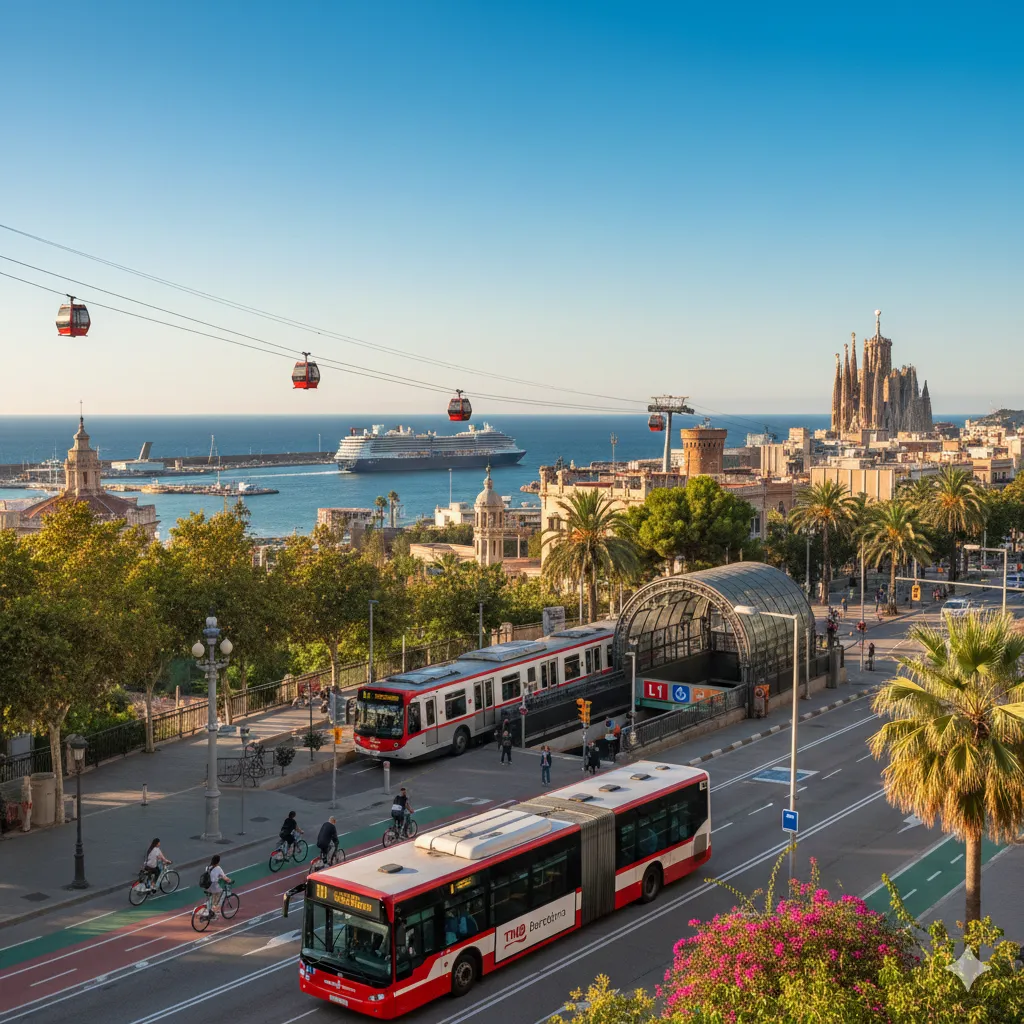
Mastering the Best Options for Barcelona Transportation and Beyond
Navigating Barcelona transportation is one of the most rewarding parts of visiting this Mediterranean jewel. Unlike many sprawling metropolises, the Catalan capital has designed a seamless, integrated network that connects the sun-drenched beaches of Barceloneta to the high-altitude views of Tibidabo. Whether you are hopping on the sleek metro, gliding on a modern tram, or taking a historic funicular, the city's transit system is your gateway to culture and history. In this guide, I recommend the best ways to move through the city, ensuring your journey is as smooth as the Mediterranean breeze.
As of 2026, the system has evolved significantly, moving toward a fully digital experience that respects both the traveler's time and the city's environmental goals. Let’s dive into how you can master the local transit like a true barcelonés.
The Evolution of Moving: Then vs. Now
To appreciate Barcelona transportation today, one must look back at its transformation. Not too long ago, travelers relied on magnetic strip paper tickets that frequently demagnetized near phones. Today, the city has transitioned to the T-Mobilitat system—a contactless card or mobile app that serves as your digital key to the city.
The buses have also seen a revolution. Where there were once loud, diesel-chugging engines, you now find a quiet fleet of hybrid and electric vehicles. The "Orthogonal Bus Network" introduced a few years ago has made the grid-like streets of the Eixample district much easier to navigate than the old, winding routes of the past.
The Backbone: The Barcelona Metro System
The Metro is, without a doubt, the fastest way to travel. With twelve lines covering the city and suburbs, you are never more than a few blocks from a station.
- Lines to Know:
- L3 (Green): This is the "tourist line." I recommend this line for visiting the Liceu Opera House, the Gothic Quarter (via Drassanes), and the stunning Parc Güell (via Vallcarca).
- L2 (Purple): Your direct link to the Sagrada Família and the Passeig de Gràcia.
- L9 Sud (Orange): The dedicated line connecting Terminal 1 and Terminal 2 of the airport to the city’s southwestern suburbs.
- Operating Hours:
- Monday to Thursday: 5:00 AM to midnight.
- Fridays: 5:00 AM to 2:00 AM.
- Saturdays: Continuous service all night.
- Sundays: 5:00 AM to midnight.
- Things to Keep in Mind: While the stations are very safe and clean, I recommend staying mindful of your personal items in crowded stations like Sants Estació or Plaça de Catalunya, just as you would in any major world city.
Organically Close: If you find yourself at the Liceu stop on L3, I recommend stepping out for a treat at Rocambolesc, an avant-garde ice cream shop by the world-famous Roca brothers.
The Surface Network: Buses and Trams
If you prefer seeing the city's architecture while you move, the bus and tram networks are spectacular.
The Bus Network (TMB)
The bus system is incredibly extensive. Look for the "V" (Vertical), "H" (Horizontal), and "D" (Diagonal) lines. They run roughly every 5 to 8 minutes during the day.
- NitBus: When the metro closes, the yellow "NitBus" takes over. It’s an excellent, cost-effective way to get back to your accommodation in the early hours of the morning.
The Tram
The Tram is one of the quietest and most scenic forms of Barcelona transportation. It primarily serves the outskirts and the developing technology districts like Poblenou.
- Trambesòs (T4, T5, T6): I recommend taking the T4 from Vila Olímpica to explore the modern side of the city. It runs past the Torre Glòries, an iconic piece of the skyline.
Organically Close: Near the Glòries tram stop, you can visit the Mercat dels Encants, one of the oldest flea markets in Europe, housed under a spectacular mirrored roof.
Reaching the Heights: Funiculars and Cable Cars
Barcelona isn't just flat; it’s a city of hills. To get the best views, you’ll need to use the vertical transport options.
- Montjuïc Funicular: This is integrated into the metro system (L3/L2 at Paral·lel). It’s a short, steep climb that puts you right in the heart of the Olympic park.
- Telefèric de Montjuïc: This is a separate cable car. While not included in standard transport passes, the view of the port is unparalleled.
- Tibidabo's "Cuca de Llum": This translates to "Glow-worm." It is a state-of-the-art funicular that takes you to the Tibidabo Amusement Park. It replaced the old funicular in 2021 and offers floor-to-ceiling glass windows.
Organically Close: After taking the Montjuïc Funicular, walk to La Caseta del Migdia for a restobar experience with one of the most hidden and beautiful sunset views in the city.
Tickets and Passes: The T-Mobilitat Era
Understanding tickets is the most practical part of Barcelona transportation. In 2026, paper tickets are largely a thing of the past for locals, but travelers have several easy options.
- T-Mobilitat (Contactless Card): You can purchase a cardboard version at any station for a small fee and reload it.
- T-Casual: This is a 10-ride pass. Note that it is individual and cannot be shared between multiple people simultaneously.
- T-Usual: If you are staying for more than 5 days and plan to travel daily, I highly recommend this. It offers unlimited rides for 30 days and usually pays for itself in about 15-20 trips.
- Hola Barcelona Travel Card: This is the best choice for short-term visitors. It covers unlimited rides on all public transport, including the airport metro.
Where to find it: Every metro station has red vending machines with a multilingual interface. You can also download the TMB App to manage your T-Mobilitat via your phone's NFC.
Airport Transfers: The Most Efficient Routes
Getting from El Prat (BCN) to the city center is straightforward, but you have choices based on your budget and destination.
- Aerobús (A1 & A2): This is my top recommendation. It departs every 5-10 minutes from both terminals and takes you directly to Plaça de Catalunya in about 35 minutes. It offers free Wi-Fi and USB chargers.
- Metro L9 Sud: Great if you are staying near the Fira (Convention Center) or the University district. Note: Standard T-Casual tickets do not cover the airport metro; you need a specific "Airport Ticket."
- Renfe Train (R2 Nord): Departs from Terminal 2. It is the cheapest option if you are using a T-Usual or T-Casual, taking you to Passeig de Gràcia in 25 minutes.
Organically Close: Once you arrive at Plaça de Catalunya via the Aerobús, treat yourself to a coffee at Café Zurich, a historic spot that has watched the city's transport evolve for over a century.
Regional Travel: Exploring Beyond the City
Barcelona is perfectly positioned for day trips. Use the FGC (Ferrocarrils de la Generalitat) or Rodalies (Renfe) trains.
- Montserrat: Take the R5 line from Plaça d’Espanya. It’s a journey that combines train and either a cable car or a rack railway.
- Sitges: Use the R2 Sud from Sants or Passeig de Gràcia. In just 35 minutes, you go from city life to a Mediterranean beach paradise.
Things to Keep in Mind: Regional trains use different zones. Barcelona city is Zone 1. Places like Montserrat or Sitges require a Zone 3 or 4 ticket. Always check the map at the ticket machine.
Sustainable Moving: Biking and Walking
Barcelona is consistently ranked as one of the most bike-friendly cities in Europe.
- Bicing: This is the city's bike-sharing program. Unfortunately, it is only available to residents with a NIE.
- Private Rentals: I recommend renting a bike from one of the many shops in the Gothic Quarter or near the Arc de Triomf. The city has over 200km of bike lanes.
- Walking: The neighborhoods of Gràcia, El Born, and the Gothic Quarter are best experienced on foot. Much of the city center is pedestrianized, allowing you to admire the "panots" (floral sidewalk tiles) that are unique to Barcelona.
Organically Close: After a bike ride along the coastline, park near Makamaka Beach Burger Cafe for a vibrant outdoor dining experience right near the sand.
Practical Tips for Your Transit Journey
- Validating: Even with contactless cards, you must "tap in" at the start of every journey. On buses, the scanners are near the doors.
- Transfers: Most tickets allow you to transfer between different modes (Metro to Bus, etc.) within 75 minutes without being charged a second ride.
- Accessibility: Barcelona's transport is highly accessible. Over 90% of metro stations have elevators, and all buses have ramps for wheelchairs and strollers.
- Peak Hours: I recommend avoiding the 8:00 AM to 9:30 AM window if you can, as this is when the city is most active with commuters.
Summary Checklist for Travelers
- Download the TMB App: For real-time schedules and digital ticket management.
- Get a T-Mobilitat card: The easiest way to store your rides.
- Check the zone map: Most sights are in Zone 1.
- Be Mindful: Keep your belongings close in busy hubs.
- Enjoy the view: Don't forget to look out the window on the tram and buses!
Barcelona's commitment to public transport makes it one of the most accessible cities in the world. By following these recommendations, you won't just be moving from place to place—you'll be experiencing the city's rhythm. Whether you are traveling by metro to see the Sagrada Família or taking the bus to a hidden tapas bar, the journey is half the fun. Enjoy the ride!