
Navigating the Best Barcelona Airport Transfers to the City Center
Landing at Josep Tarradellas Barcelona-El Prat Airport (BCN) is often the first moment you feel the warm Mediterranean breeze and hear the melodic tones of Catalan. As you step off the plane, your primary goal is to reach your accommodation smoothly. I recommend viewing your transfer not just as a commute, but as the first chapter of your Barcelona adventure. Whether you are arriving at the sleek, modern Terminal 1 or the historic, mural-adorned Terminal 2, understanding Barcelona Airport Transfers is key to starting your trip on a high note.
The airport has undergone massive transformations. What used to be a singular, smaller hub has evolved into a world-class facility. In the past, travelers had fewer choices, often relying on a single train line or expensive taxis. Today, you have a sophisticated multi-modal system including the Aerobús, the Metro, regional trains, and eco-friendly taxi fleets.
Understanding the Layout of Josep Tarradellas Barcelona-El Prat Airport
Before choosing your ride, you must know where you are. The airport is split into two main terminals located a few kilometers apart.
- Terminal 1 (T1): This is the newer, larger terminal designed by architect Ricardo Bofill. It handles most international and major carrier flights. It is shaped like a giant "V" or a sword and is a bright, airy space. Terminal 1 on Google Maps
- Terminal 2 (T2): This terminal is divided into T2A, T2B, and T2C. It mostly serves low-cost carriers. I find the exterior of T2B particularly charming because of the iconic ceramic mural by Joan Miró, which has greeted travelers since the 1970s. Terminal 2 on Google Maps
Pro Tip: There is a free shuttle bus (Bustransit) that connects the two terminals 24/7. If you land at T1 but need the train (which departs from T2), look for the green bus. It’s a great spot to catch a quick view of the runways.
The Aerobús: Your Reliable Blue Link to the Heart of the City
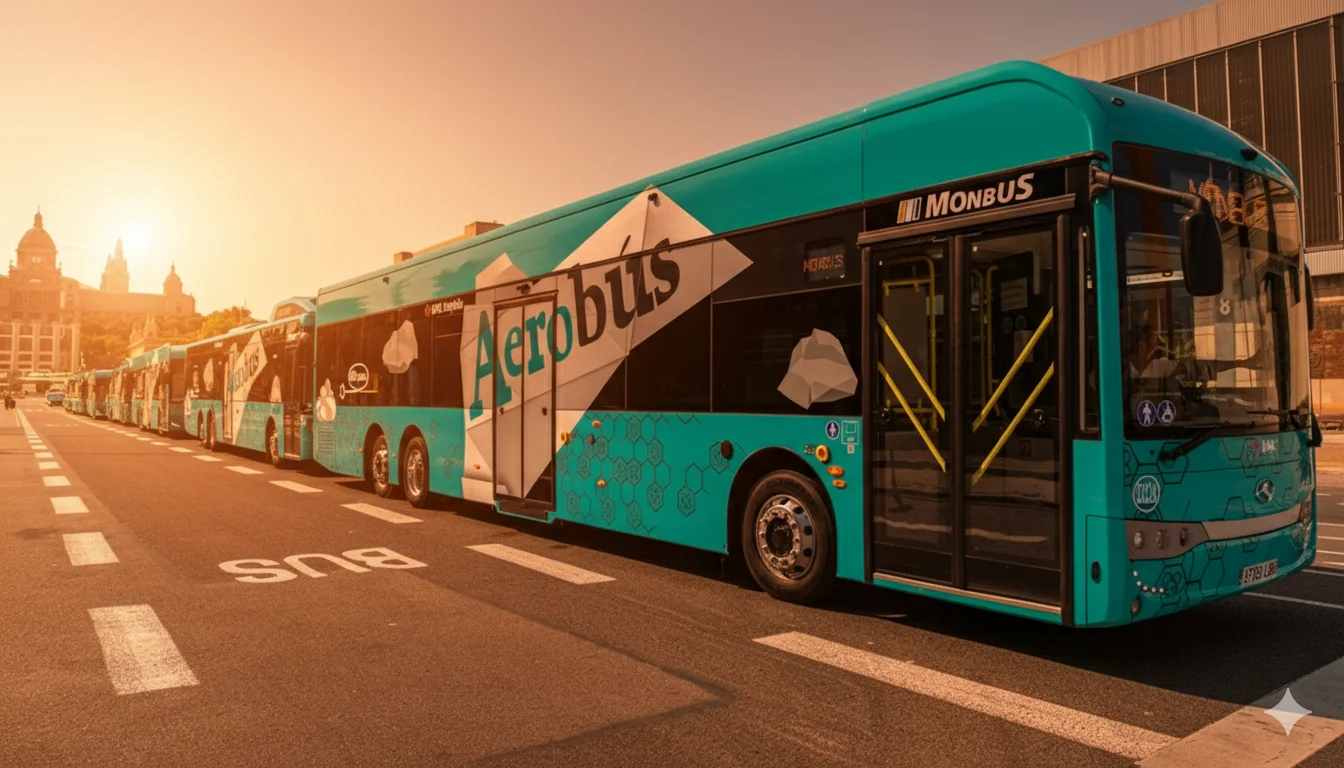
I highly recommend the Aerobús if you are staying near Plaça de Catalunya or Plaça d'Espanya. These bright blue buses are impossible to miss and offer a direct, high-frequency service.
- How it works: There are two lines: A1 (from Terminal 1) and A2 (from Terminal 2).
- The Experience: Inside, you will find luggage racks, free Wi-Fi, and USB charging ports. It’s a comfortable way to transition from the airport to the urban bustle.
- Route: The bus stops at key locations like Sepúlveda-Urgell and Plaça d'Espanya before ending at Plaça de Catalunya.
- Timings: This service runs 24 hours a day, 365 days a year. During peak hours, they depart every 5 to 10 minutes.
Then vs. Now: Years ago, the airport bus was a standard city bus with limited luggage space. Now, the Aerobús is a dedicated fleet specifically designed for travelers, making the journey much faster by using dedicated bus lanes.
Riding the Rails: The Rodalies R2 Nord Train Experience
The train is a fantastic option if you want to avoid traffic and are heading toward Sants Estació or Passeig de Gràcia. However, there is a catch: the train station is only located at Terminal 2.
- The Connection: If you land at T1, you must take the free shuttle to T2 to catch the train.
- The Route: The R2 Nord line takes you to Barcelona-Sants, the city’s main rail hub, in about 20 minutes.
- Why choose the train? I recommend this for travelers who are comfortable navigating train stations and want to connect to other parts of Catalonia or Spain immediately.
- Timings: Trains usually run from around 5:30 AM to 11:30 PM.
Insider Tip: When you arrive at the T2 station, you will walk across a long, glass-covered bridge. It feels like a vintage sci-fi movie set and offers a great panoramic view of the T2 tarmac.
The Metro L9 Sud: Connectivity for Business and Leisure
In 2016, the L9 Sud Metro line was inaugurated, changing the landscape of Barcelona Airport Transfers forever. Unlike the train, the Metro has stations at both T1 and T2.
- Best for: Those staying near the Fira Gran Via exhibition center or in the south of the city (L'Hospitalet).
- The Experience: This is an automated, driverless metro line. It is very modern, but keep in mind that it doesn't go directly to Plaça de Catalunya. You will likely need to transfer to the L1 (Red Line) or L5 (Blue Line) to reach the historical center.
- Timings:
- Monday to Thursday: 5:00 AM to Midnight.
- Friday: 5:00 AM to 2:00 AM.
- Saturday: Runs all night.
- Sunday: 5:00 AM to Midnight.
Aeroport T1 Metro Station on Google Maps
Taxis and Private Transfers: Door-to-Door Comfort
If you are traveling with a lot of luggage or in a group of three or four, a taxi is a great place to spend your transport budget. Barcelona’s taxis are iconic with their black and yellow livery.
- Where to find them: Look for the "Taxi" signs as soon as you exit the baggage claim. There are organized queues with attendants who will help you into a vehicle.
- Ride-sharing: Apps like Free Now, Cabify, and Uber operate in the city, but they have specific pickup points (often in the parking garages), so follow the app's instructions carefully.
- What to expect: Taxis are metered, but there is a minimum airport fee and supplements for suitcases. It’s a stress-free way to reach your hotel doorstep.
Dining and Relaxation Near the Transfer Hubs
If you have a bit of time before your bus or train departs, or if you are waiting for a friend to land, there are some great spots to grab a bite.
Within Terminal 1
- Porta Gaig: For a high-end experience, I recommend this restaurant by Michelin-starred chef Carles Gaig. It is located in the public area of T1. It’s a far cry from typical airport fast food.
- Boldú: If you have a sweet tooth, look for Boldú. They are famous for their "Bolduman"—star-shaped gingerbread-style pastries that are local favorites. Boldú T1 on Google Maps
Near Terminal 2
- Slam Gourmet: A great place for a quick Mediterranean sandwich (bocadillo) before you hop on the R2 train.
Once You Reach the City Center (Plaça de Catalunya)
Once your transfer drops you off, you are in a foodie paradise.
- Café de l'Opera: A 5-minute walk from the Aerobús stop. It’s a historic cafe where you can enjoy traditional churros with chocolate. Café de l'Opera on Google Maps
- Teresa Carles: One of the city’s best vegetarian restaurants is just a few blocks away from the bus terminal. I recommend their healthy juices after a long flight. Teresa Carles on Google Maps
Essential Things to Keep in Mind for a Smooth Arrival
To ensure your journey into Barcelona is as pleasant as possible, keep these practical points in mind:
- Validate Your Ticket: Whether you are on the train or the metro, you must validate your ticket at the barriers. On the bus, the driver or an attendant will check it.
- The "Airport Supplement": If you use a standard T-casual travel card for the Metro, it will not work for the airport stations. You need a specific airport ticket. However, the Hola Barcelona Travel Card includes the airport journey.
- Stay Alert: While the transit system is very safe and well-monitored, transit hubs are busy places. I recommend keeping your bags in front of you and being mindful of your personal items in crowded areas.
- Accessibility: Barcelona's transport is highly accessible. Buses have ramps, and almost all Metro stations and both airport terminals have elevators.
Terminal 1 vs. Terminal 2: A Comparison Through Time
The history of these terminals reflects Barcelona's growth. Terminal 2 was the gateway for the 1992 Olympics. It has a nostalgic, busy feel with its low ceilings and older architecture. I love the "B" section of T2 for its classic vibe.
Terminal 1, opened in 2009, represents the new Barcelona: sleek, efficient, and filled with natural light. When you move between them via the shuttle, you can see the contrast between the mid-century functionality of T2 and the futuristic design of T1.
Where to find the shuttle:
- At T1: Outside the arrivals hall on the ground floor.
- At T2: Under the bridge outside the T2B terminal.
Do's and Don'ts of Barcelona Airport Transport
Do's
- Do check your terminal twice: Many airlines change terminals periodically. Double-check your departure terminal before you leave the city.
- Do use the Aerobús for late-night arrivals: When the trains stop, the Aerobús is your best friend.
- Do ask for a receipt in taxis: If you leave something behind, the receipt has the taxi ID number which makes recovering items much easier.
- Do enjoy the view: If you take the Aerobús or a taxi, look out for the Venetian Towers as you enter Plaça d'Espanya. It’s a grand entrance to the city.
Don'ts
- Don't buy the wrong Metro ticket: Standard single tickets won't get you past the turnstiles at the airport stations. Look for the "Airport" button on the machines.
- Don't take the train if you are in T1 and in a rush: The shuttle to T2 can take 10-15 minutes, plus the wait for the train. In this case, the Aerobús or Metro is faster.
- Don't forget to mask up if regulations require: While many restrictions have eased, check local transit signage for current health and safety protocols.
Seasonal Considerations and Peak Travel Times
Barcelona is a city of festivals. During events like Primavera Sound or the Mobile World Congress (MWC), airport transfers can get very busy.
- Summer (June to August): Expect longer queues for taxis and the Aerobús. I recommend giving yourself an extra 30 minutes.
- Winter (November to February): The weather is generally mild, but rainy days can cause traffic delays for buses and taxis. The Metro and Train are your most reliable options when the streets are wet.
- Local Holidays: On days like September 11th (Diada) or September 24th (La Mercè), some bus routes in the city center might be diverted due to parades.
Why I Recommend Planning Your Transfer Ahead
There is nothing quite like the feeling of landing in a new city and knowing exactly where you are going. Barcelona is a welcoming place, and the infrastructure is designed to make your life easy. By choosing the right Barcelona Airport Transfer based on your destination and group size, you save time for what really matters: enjoying the tapas, the architecture, and the sun.
If you are a first-time visitor, I recommend the Aerobús. It is simple, direct, and drops you in the center of everything. If you are a seasoned traveler or on a budget, the R2 Nord train provides a local perspective and a quick route to the main station.
No matter which mode of transport you choose, the journey from El Prat to the city is a transition into the vibrant Catalan culture. So, grab your bags, follow the signs, and prepare to fall in love with Barcelona.
Summary of Transfer Options
- Aerobús: 24/7, ends at Plaça de Catalunya.
- Train (R2 Nord): T2 only, ends at Sants/Passeig de Gràcia.
- Metro (L9 Sud): Connects both terminals to the southern metro network.
- Taxi: Available 24/7 at all terminal exits.
- Free Terminal Shuttle: Connects T1 and T2 every 5-10 minutes.
Your journey is about to begin. Welcome to Barcelona!