
Exploring Casa Mila: The Ultimate Guide to Architecture in Barcelona
When you stand at the corner of Passeig de Gràcia and Carrer de Provença, your eyes are immediately drawn to a building that looks less like a residence and more like a wave frozen in stone. This is Casa Milà, affectionately known by locals as La Pedrera (The Quarry). I recommend this place as an essential stop because it represents the absolute peak of Antoni Gaudí’s civic architecture. It is a building that breathes, curves, and defies the traditional laws of geometry.
In this guide, I will take you through the undulating hallways, the surreal rooftop, and the hidden history of this UNESCO World Heritage site. Whether you are a fan of radical design or simply want to see one of the most famous views in Spain, Casa Milà offers an experience that is both intellectually stimulating and visually breathtaking. You can find this masterpiece located at Passeig de Gràcia, 92, 08008 Barcelona, Spain.
A Tale of Two Names: Past vs. Present
To truly understand Casa Milà, you have to appreciate the controversy it caused when it was first built.
How it Used to Be
In 1906, when Pere Milà and Roser Segimon commissioned Gaudí to build their new home, they wanted something that would scream prestige. However, what Gaudí delivered was so radical that it became the laughingstock of Barcelona. The locals mocked its heavy, rugged stone exterior, giving it the nickname "La Pedrera" (The Quarry) as an insult. Cartoons in the newspapers of the time depicted the building as a garage for zeppelins or a giant cake gone wrong. Even the local government fined Milà because the building's massive pillars encroached on the sidewalk.
What it is Now
Today, that "insult" has become a badge of honor. La Pedrera is celebrated worldwide as a masterpiece of structural engineering. It was the last private residence Gaudí designed before dedicating himself entirely to the Sagrada Família. What was once seen as an eyesore is now a cultural hub, hosting jazz concerts, art exhibitions, and thousands of awe-struck visitors daily. Interestingly, it is still a functioning apartment building; a few lucky families still live in the private wings of the house, maintaining a link to its original purpose.
The Exterior: The Stone Wave
I recommend starting your visit by simply standing across the street to take in the facade. You will notice that there are no straight lines. Gaudí wanted to mimic the organic shapes of nature—specifically the mountains of Montserrat or the waves of the Mediterranean.
- The Wrought Iron Balconies: These were designed by Josep Maria Jujol, a close collaborator of Gaudí. Each of the 32 balconies is unique, made from recycled iron scraps that look like tangled seaweed or coral.
- The Self-Supporting Facade: One of Gaudí’s greatest innovations here was that the stone exterior doesn't actually support the weight of the floors. Instead, he used a system of pillars and beams, which allowed him to create an "open plan" interior where walls could be moved or removed entirely.
The Warrior Rooftop: A Surrealist Dreamscape
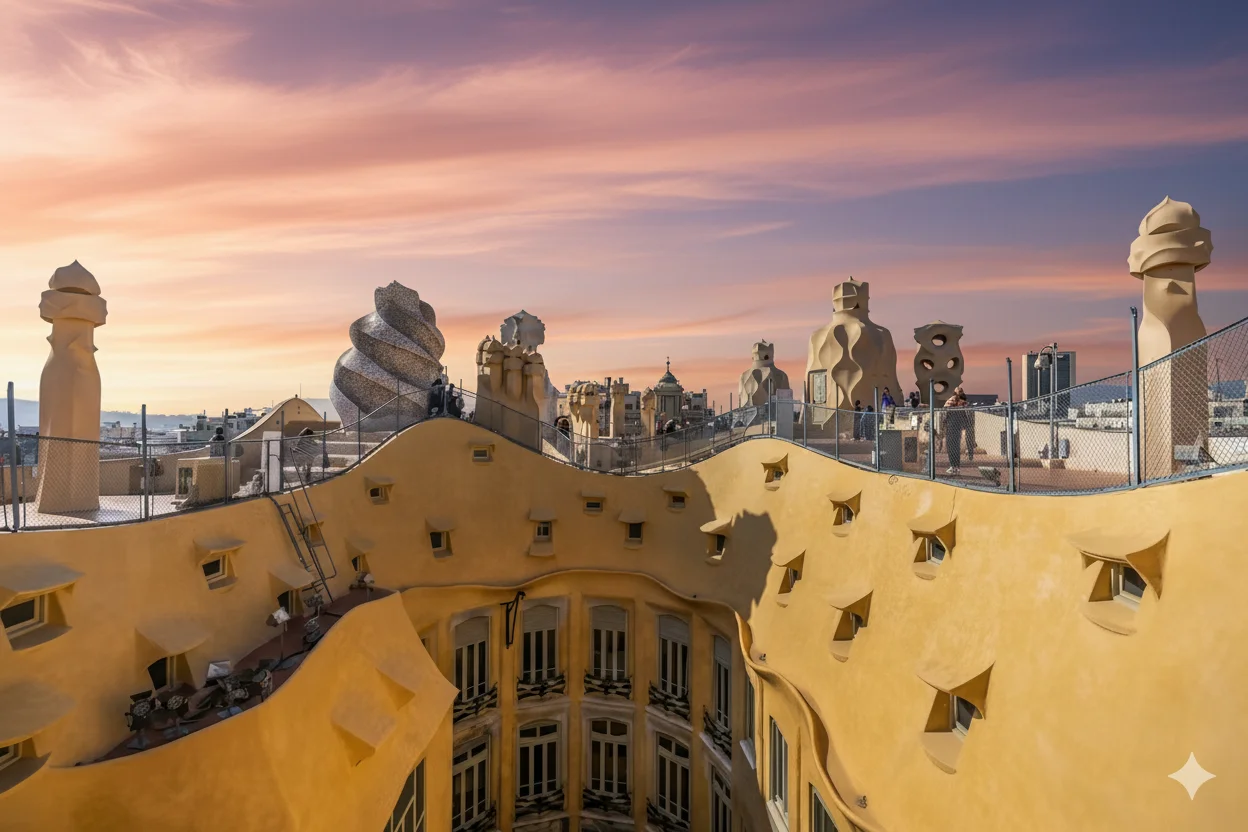
The highlight for most visitors—and the spot I suggest you spend the most time on—is the rooftop. It is unlike any other roof in the world.
The Chimneys and Vents
Gaudí took functional elements like chimneys and ventilation shafts and turned them into art. You will see groups of "warrior" chimneys that look like knights in helmets. Some are covered in trencadís (broken ceramic fragments), while others are topped with green glass from recycled cava bottles.
The Views
From the undulating steps of the roof, you get a perfect "frame" of the Sagrada Família through one of the stone arches. It is a great spot to spend time on during the "golden hour" as the sun sets over the Eixample district.
- Night Experience: If you visit in the evening, they offer a show called "La Pedrera Night Experience," which includes light projections on the chimneys and a glass of cava. It is a magical way to see the architecture under the stars.
Inside the Whale: The Attic (Espai Gaudí)
After exploring the roof, you will descend into the attic. If you look up at the ceiling, you will see 270 catenary arches made of brick. It feels exactly like walking through the ribcage of a giant whale.
This space was originally used as a laundry and storage area for the residents, but today it houses the Espai Gaudí, a museum dedicated to his life and work. I recommend spending time here to see the scale models and natural objects (like honeycombs and seashells) that inspired Gaudí’s designs. It helps you understand that his "crazy" shapes were actually based on very precise mathematical laws found in nature.
The Bourgeois Life: The Pedrera Apartment
One floor below the attic, you can step back in time to the early 20th century. One of the apartments has been perfectly restored with period furniture and decor.
- Daily Life: You can walk through the kitchen, the children's rooms, and the elegant dining room. It gives you a clear picture of how a wealthy family lived in the 1910s.
- The Details: Pay attention to the doorknobs and window handles. Gaudí designed them to be ergonomic, fitting the shape of the human hand perfectly. Even the floor tiles have organic patterns of starfish and seaweed.
The Courtyards: Light and Color
Gaudí designed two massive internal courtyards—the Flower Courtyard and the Butterfly Courtyard—to ensure that every single room in the building received natural light and fresh air.
- The Flower Courtyard: Located on the Passeig de Gràcia side, it features beautiful murals of floral motifs and a grand staircase that leads up to the Milà family's main residence.
- The Butterfly Courtyard: Named for the wing-like shapes of its roof structure, this courtyard feels like a secret garden hidden within the stone walls.
Essential Visit Information
To make the most of your journey to Casa Milà, here are the practical details you need.
Opening and Closing Hours
Casa Milà is generally open every day, but hours can vary slightly during holidays.
- Daytime Visit: 9:00 AM to 8:30 PM.
- Night Visit: 9:00 PM to 11:00 PM.
- Best Time to Visit: I recommend booking the first slot at 9:00 AM or a late afternoon slot around 6:00 PM. This helps you avoid the busiest midday crowds and gives you the best lighting for photography.
Things to Keep in Mind
- Tickets: You must book in advance online. There is a specific entry time on your ticket, so try to arrive 10-15 minutes early.
- The Lift: There is an elevator that takes you directly to the roof, but you will need to walk down the stairs to see the attic and the apartment.
- Accessibility: The building is mostly accessible for people with reduced mobility, including a specially designed ramp on the rooftop.
Where to Eat and Relax Nearby
The Passeig de Gràcia area is one of the best for dining, ranging from historic cafes to Michelin-starred gems.
For Coffee and Light Bites
- Café de la Pedrera: Located on the ground floor of the building itself, this cafe has a stunning undulating ceiling that mimics the rest of the house. It’s a great spot to sit and soak in the atmosphere after your tour.
- Laie Libreria Cafe: Just a few blocks away, this is a bookstore with a hidden terrace cafe on the upper floor. It is very peaceful and popular with locals.
For Tapas and Dinner
- Bar Mut: A sophisticated, high-end tapas bar that feels like a classic Parisian bistro but with incredible Catalan ingredients. Their seafood is exceptional.
- Tragaluz: A stylish restaurant with a glass roof that lets you dine under the stars. It serves modern Mediterranean cuisine and is perfect for a special night out.
Dessert and Ice Cream
- Rocambolesc: Located inside the nearby Gran Hotel Calderón, this ice cream shop is run by the world-famous Roca brothers. The decor is inspired by Willy Wonka, and the flavors are incredibly creative.
Nearby Experiences to Pair with Your Visit
Since Casa Milà is centrally located, you can easily combine it with other activities.
- Casa Batlló: Located just three blocks down the street. While Casa Milà is rugged and "masculine," Casa Batlló is colorful and "feminine." Seeing both on the same day gives you a complete picture of Gaudí’s versatility.
- Fundació Antoni Tàpies: A stunning modernist building topped with a massive wire sculpture, dedicated to one of Catalonia’s most famous modern artists.
- Luxury Shopping: Passeig de Gràcia is Barcelona's answer to the Champs-Élysées. Even if you aren't shopping, the window displays are a form of art in themselves.
Do’s and Don’ts for a Smooth Experience
- DO use the audio guide. It is included in the ticket and provides essential context about why the building is designed the way it is.
- DON'T touch the murals or the furniture in the apartment. These are delicate historical artifacts.
- DO look at the floor. The hexagonal tiles on Passeig de Gràcia outside the building were also designed by Gaudí and are now a symbol of the city.
- DON'T forget to look up while in the courtyards. The perspective from the bottom looking at the sky is one of the best views of the building.
- DO stay mindful of your personal belongings in the crowded areas outside the entrance. The area is safe, but it’s always good to be attentive when you are in a high-traffic tourist zone.
- DON'T rush the rooftop. Most people spend 15 minutes there, but I suggest taking 45 minutes to walk every level and see the chimneys from different angles.
Final Thoughts
Casa Milà is more than just a house; it is a philosophy in stone. It tells the story of a man who looked at the world and saw no straight lines, only the curves of the earth and the sky. Visiting La Pedrera allows you to step inside that vision.
I recommend that you don't just look at the building as a photo opportunity, but as a living piece of history. Take a moment to sit in the courtyard, listen to the echoes of the "Warrior" rooftop, and imagine what it must have been like to live in such a revolutionary space in 1912. Barcelona is a city of layers, and Casa Milà is one of its most fascinating. Enjoy the curves, the light, and the enduring legacy of Gaudí’s "Quarry."