
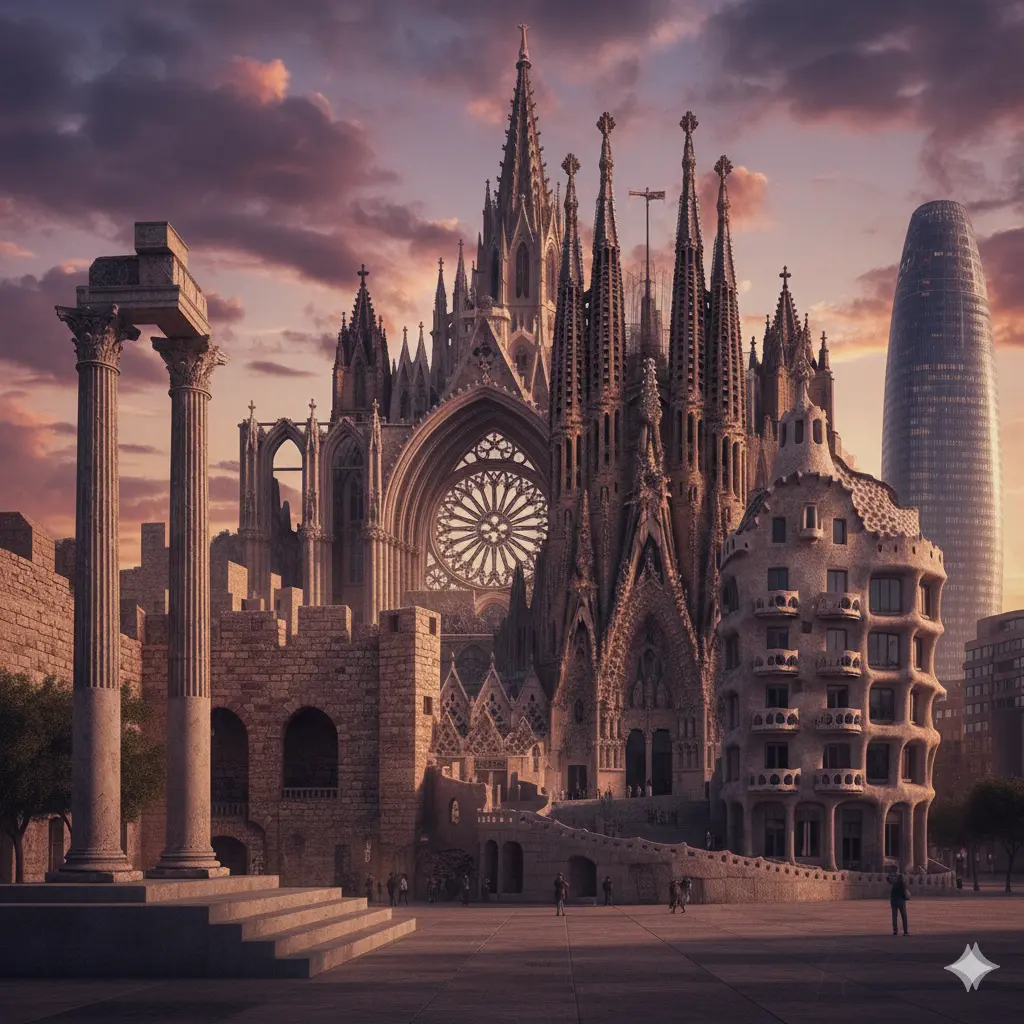
Medieval Barcelona Guide: Rise of the Gothic Quarter
When you step into the Gothic Quarter (Barri Gòtic) in 2026, you are not just entering a neighborhood; you are walking into the era that defined Catalonia's soul. While the Romans laid the first stones, it was the Medieval period—specifically the 13th to 15th centuries—that built the soaring skyline and the fierce independent spirit you feel today.
For the first-time traveler, these winding streets can feel like a stone labyrinth designed to confuse you. And in a way, they were. But they were also designed to protect, to impress, and to house a maritime empire that once ruled the Mediterranean.
This guide will help you navigate the shadows and light of Medieval Barcelona, comparing the powerful merchant city of the past with the vibrant cultural hub of the present. Here is your roadmap to the "Golden Age."
The Labyrinth: Entering the Gothic Quarter
Then: A Walled City of Guilds
In the Middle Ages, Barcelona was bursting at the seams. The population was growing rapidly, fueled by trade with the Orient and Africa. The streets were organized not by logic, but by trade. You had streets dedicated to silversmiths, glassmakers, and shoemakers. It was noisy, smelly, and incredibly wealthy. The city was protected by walls (parts of which you can still see), and the gates closed at sunset.
Now: The Heart of the Old City
Today, the walls are mostly gone, replaced by grand avenues, but the footprint remains. The Barri Gòtic is the heart of Ciutat Vella (Old City).
- The Experience: You will find that GPS often fails here due to the narrow, high walls. Do not worry. Getting lost is the best way to find hidden plazas.
- What Changed: The smell of leather and iron has been replaced by the aroma of coffee and fresh pastries. The workshops are now boutique shops, vintage stores, and small galleries.
Insider Tip for 2026: The best time to feel the medieval atmosphere is before 9:00 AM. The delivery trucks are gone, the tourists haven't arrived, and your footsteps on the cobblestones will echo just as they did 600 years ago.
- Location: Barri Gòtic on Google Maps
The Cathedral of the Holy Cross and Saint Eulalia
Many visitors rush to the Sagrada Familia (which is a masterpiece of the 20th century), but to understand the medieval mind, you must visit La Seu, the Cathedral of Barcelona.
The Façade Illusion
Then vs. Now: Here is a secret: the neo-Gothic façade you see today, with its intricate archways and gargoyles, was actually built in the late 19th and early 20th centuries to "beautify" the city for the World Fair.
- The Reality: The bones of the building, the interior, and the sides are authentic 13th-15th century Gothic. Originally, the front was much plainer.
The Cloister of the Geese
The Tradition: Walk into the cloister (the courtyard). You will see palm trees, a fountain, and exactly 13 white geese.
- Why? Legend says they represent the age of Saint Eulalia, the co-patron saint of the city, when she was martyred in Roman times. This tradition has been kept alive for centuries. The geese were excellent "watchdogs" against intruders in medieval times due to their loud honking.
Visitor Guide:
- Dress Code: Shoulders and knees must be covered. They are strict about this.
- Roof Access: Take the elevator to the roof. You will see the city from the perspective of a medieval bell-ringer. You can also spot the spires of the Sagrada Familia in the distance, offering a perfect visual comparison of the old and the new.
- Location: Catedral de Barcelona on Google Maps
Plaça del Rei: The Time Capsule
If you want to see exactly what the city looked like in the 1400s, go to Plaça del Rei (King's Square).
The Royal Seat
Then: This was the courtyard of the Palau Reial Major, the residence of the Counts of Barcelona and Kings of Aragon. It was the center of political power.
- The Columbus Connection: It is widely believed (though historically debated) that on the steps of this square, King Ferdinand and Queen Isabella received Christopher Columbus upon his return from the Americas in 1493.
Now: It is one of the quietest, most majestic spots in the city. The three buildings surrounding it—the Tinell Hall, the Chapel of St. Agatha, and the Lieutenant’s Palace—create a seamless medieval wall.
- Atmosphere: Street musicians, often playing Spanish guitar or cello, love this spot for its incredible acoustics. It is hauntingly beautiful at dusk.
Nearby Cultural Experience: Just a few minutes' walk from this royal setting is the Barcelona City Hall Theater. While the Plaça del Rei offers the silence of history, the theater offers the passion of tradition. Catching a Flamenco Show here bridges the gap between the historic stone surroundings and the fiery, living culture of Spain.
- Location: Plaça del Rei on Google Maps
- Experience: Barcelona City Hall Theater on Google Maps
El Call: The Jewish Quarter
Deep within the Gothic Quarter lies a network of streets even narrower than the rest. This is El Call.
A City Within a City
Then: Until the attacks of 1391, this was a thriving Jewish community. It was a center of learning, medicine, and translation. The community lived somewhat separately, with its own schools, baths, and synagogues. The streets were designed to be defensible.
Now: The physical history was largely erased or built over, but the layout remains.
-
Sinagoga Major: One of the oldest synagogues in Europe was rediscovered here. It sits below current street level, showing how the city has risen in height over centuries of paving and repaving.
-
What to look for: On the stone doorframes of some shops and houses, you can still see small indentations where the mezuzah (a parchment with religious text) used to be placed.
-
Location: El Call de Barcelona on Google Maps
Santa Maria del Mar: The People's Church
While the Cathedral was for the royals and the clergy, the Basilica of Santa Maria del Mar belonged to the people.
The Stones of the People
Then: Built in the 14th century in the Ribera district, this church was funded and built by the locals—the sailors, the merchants, and specifically the bastaixos (dock porters). These men carried massive stones from the royal quarry on Montjuïc all the way to the construction site on their backs.
- The Tribute: Look closely at the main wooden doors. You will see small metal figures of the porters carrying stones, honoring their sacrifice.
Now: It is considered the purest example of Catalan Gothic architecture. Unlike French Gothic, which tries to reach high with thin spires, Catalan Gothic focuses on breadth and unity. The interior is spacious, airy, and largely unadorned (due to a fire during the Civil War that burned the baroque wooden decorations, accidentally restoring it to its original medieval purity).
Nearby Maritime Connection: The people who built this church lived off the sea. To continue that maritime theme, you can walk from the church down to the Old Port (Port Vell). Here, the Barcelona Aquarium offers a modern look at the Mediterranean life that sustained the medieval city. It is a fantastic contrast: from the stone tribute to the sea to the living ocean itself.
- Location: Santa Maria del Mar on Google Maps
- Nearby: Barcelona Aquarium on Google Maps
Carrer Montcada: The Medieval Beverly Hills
Leaving the church, walk down Carrer Montcada.
The Street of Palaces
Then: In the medieval period, this was the most prestigious address in Barcelona. Wealthy merchants built "Civil Gothic" palaces here. These homes featured a central courtyard, an external staircase leading to the noble floor, and open galleries at the top.
Now: Today, this street is the cultural artery of the El Born district. The merchants are gone, but the palaces have been preserved as museums.
Art Meets History
- Picasso Museum Barcelona: Housed across five adjoining medieval palaces. The contrast is stunning: 13th-century stone arches hosting the 20th-century revolutionary art of Pablo Picasso. It focuses on his formative years in Barcelona.
- Moco Museum: Located right next door in the Palau Cervelló (a 16th-century private residence). This museum brings modern and contemporary art (Banksy, KAWS) into the historic setting. It perfectly encapsulates the theme of "Old Stones, New Ideas."
- Tip: Both museums are incredibly popular. For 2026, booking tickets online at least two weeks in advance is highly recommended.
- Location: Carrer Montcada on Google Maps
- Attraction: Picasso Museum on Google Maps
- Attraction: Moco Museum on Google Maps
Plaça Sant Jaume: The Continuity of Power
Your tour of the medieval city isn't complete without standing in Plaça Sant Jaume.
Then & Now: This square has been the center of political life since the Roman times (it was the Forum). However, the two buildings facing each other are medieval powerhouses:
- Palau de la Generalitat: The seat of the Catalan Government. It is one of the few medieval buildings in Europe still used for its original purpose.
- City Hall (Ajuntament): The center of city administration.
The Atmosphere: This is where the city celebrates and protests. If you visit on a Sunday evening or during a festival, you might see locals dancing the Sardana—a traditional circle dance that symbolizes unity. It is a living tradition held in the arms of history.
- Location: Plaça de Sant Jaume on Google Maps
A Musical Interlude: Palau de la Música Catalana
While physically located just on the edge of the medieval quarter in the Sant Pere neighborhood, no cultural itinerary is complete without the Palau de la Música Catalana.
Although built later (during the Modernisme period), it sits tightly packed into the medieval street grid. It is the only concert hall in the world to be a UNESCO World Heritage site.
-
The Experience: If the Cathedral represents the darkness and mystery of the Middle Ages, the Palau represents an explosion of light and color.
-
Recommendation: Don't just look at the outside. Get Palau de la Música Catalana Entry Tickets to see the stained-glass skylight. It is breathtaking.
Medieval Tastes: Dining in History
You cannot understand a culture without tasting it. Medieval Catalan cuisine was rich, mixing sweet and savory flavors (a legacy of Arab influence), using honey, almonds, and roasted meats.
Where to Eat in 2026
You don't need to eat like a peasant to eat history.
- Els 4 Gats: While famous for being Picasso’s hangout (Modernist era), the building feels like a medieval tavern and serves classic Catalan dishes.
- 7 Portes: Located near the port, offering historic charm and arguably the best Paella in the city (though Paella is Valencian, the Parellada rice is local).
- Bodega La Palma: In the Gothic Quarter. A classic old-school spot for wine and tapas surrounded by barrels.
What to Try
- Botifarra amb mongetes: Sausage with white beans. Simple, hearty, ancient.
- Escalivada: Roasted vegetables (peppers, eggplant).
- Crema Catalana: The local version of crème brûlée, with a history dating back to medieval recipe books.
Beyond the Walls: Contrasting Views
To truly appreciate the density of the Medieval city, you need to step away from it.
Montjuïc Cable Car: Take a trip up the Montjuïc Cable Car. From the gondola, you can look down and clearly see the dark, dense patch of the Gothic Quarter standing out against the organized grid of the rest of the city. It gives you a bird's-eye view of history.
Green Escape: Medieval cities were stone jungles. If you need a break, head to the Parc de la Ciutadella, located just past the Born district. Inside, you will find the Barcelona Zoo, a perfect spot for families to relax after a morning of history.
- Attraction: Montjuïc Cable Car on Google Maps
- Attraction: Barcelona Zoo on Google Maps
Practical Guide for the 2026 Traveler
Best Time to Visit
- Season: Spring (April-May) and Autumn (October-November) are ideal. The stone streets trap heat, making July and August very humid.
- Time: Early morning (8:00 AM - 10:00 AM) for photography and atmosphere. Late evening (after 8:00 PM) for dining and nightlife.
Costs & Budgeting
- Walking: Free!
- Cathedral: Tourist entry is approx €9-10 (Free for worship at specific times).
- Picasso Museum: Approx €15.
- Food: Lunch menu (Menu del Dia) €15-€20. Dinner €30+.
Insider Tips
- Footwear: Leave the heels at home. The cobblestones are uneven and unforgiving.
- Respect: The Gothic Quarter is a living neighborhood. People sleep in those buildings. Keep noise down late at night.
- Water: Carry a reusable bottle. There are drinking fountains throughout the old city.
Safety
Barcelona is a safe city, but the Gothic Quarter can be crowded.
- Awareness: Be mindful of your surroundings in tight crowds, especially watching street performers or near the Cathedral. Keep your bag zipped and in front of you.
- Navigation: It is easy to get disoriented. If you feel lost, walk downhill to reach the sea or uphill to reach Plaça Catalunya.
Conclusion: The Living Stone
The Gothic Quarter is not a museum wrapped in glass; it is a living, breathing organism. It has survived plagues, wars, and bombings, yet it remains the soul of Barcelona.
As you walk under the Bridge of Sighs on Carrer del Bisbe or touch the ancient stones of the Royal Palace, remember that you are adding your own story to millions of others who have walked these streets. The Medieval city doesn't just tell you about the past; it invites you to get lost in it.
So, put away your map for a moment. Turn down that narrow, shadowed alleyway. You never know what century you might find around the corner.
Quick Reference: Medieval Highlights Map
- Start: Catedral de Barcelona (Visit the Geese).
- Walk: Behind the cathedral to Plaça del Rei.
- Explore: The narrow alleys of El Call.
- Visit: Plaça Sant Jaume (Government buildings).
- Cross: Via Laietana to enter El Born.
- Admire: Santa Maria del Mar.
- Culture: Picasso Museum on Carrer Montcada.
- Relax: Walk to Port Vell near the Aquarium.