
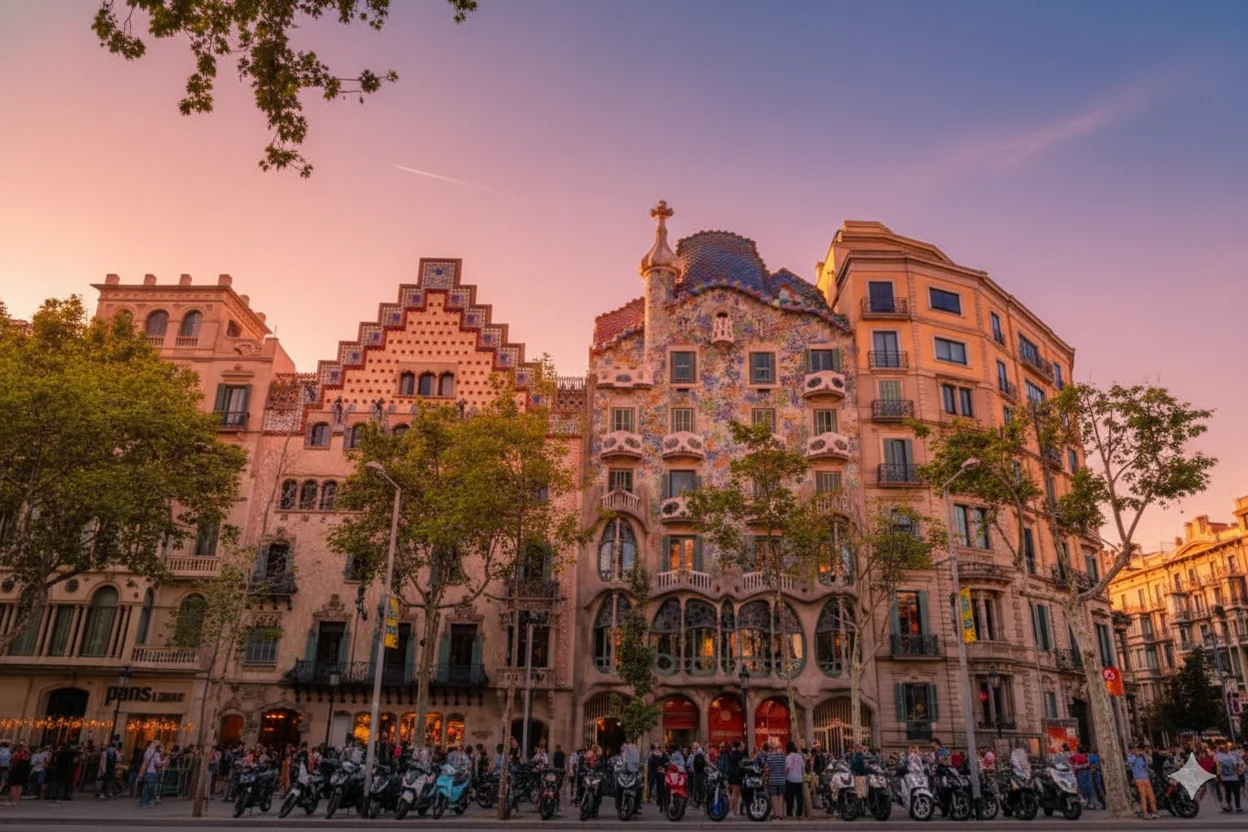
Guide to Casa Batllo: Experience Gaudí's Magical Work in Barcelona
Standing on the elegant Passeig de Gràcia, your eyes are naturally drawn to a building that looks like it was plucked straight from a dream—or perhaps the depths of the ocean. Casa Batlló is one of the most iconic landmarks in Spain, representing the pinnacle of Antoni Gaudí’s creative genius. I recommend this place as a cornerstone of any Barcelona visit, not just for the photos, but for the way it challenges your perception of what a "house" can be.
This isn't just a building; it is a legendary tale told through stone, glass, and ceramics. Whether you are an architecture student or a curious traveler, Casa Batlló offers a sensory journey unlike any other. In this guide, I’ll share how to make the most of your visit, where to find the best local bites nearby, and what secrets lie behind that famous "skeletal" facade.
The Transformation: From Ordinary to Extraordinary
To appreciate Casa Batlló, you must understand its history. It wasn't always the masterpiece you see today.
How it Used to Be
In 1877, the building was a perfectly normal, somewhat boring rectangular house designed by Emilio Sala Cortés (who, ironically, was one of Gaudí’s professors). It was a traditional structure of the era—stiff, symmetrical, and unremarkable compared to the flamboyant neighbors that would soon pop up. In 1903, it was purchased by Josep Batlló, a prominent textile industrialist. He originally wanted to tear the whole thing down because it looked too plain for the prestigious Passeig de Gràcia.
What it is Now
Instead of demolition, Gaudí convinced Batlló to allow a total renovation between 1904 and 1906. Gaudí added two extra floors, completely reshaped the facade, and turned the interior into a fluid, organic space. Today, it is a UNESCO World Heritage site and a global symbol of Catalan Modernism. You can find this architectural wonder at Passeig de Gràcia, 43, 08007 Barcelona, Spain.
The Facade: A Story of Legends
The exterior is often called the "House of Bones" (Casa dels Ossos) or the "House of Yawns." As you stand on the sidewalk looking up, I recommend taking a moment to observe the different textures.
- The "Bones": The balconies look like fragments of skulls, and the supporting pillars on the first floor resemble human limb bones.
- The "Dragon’s Back": Look at the roof. The tiles are iridescent and shaped like the scales of a giant reptile. A popular theory is that the building represents the legend of Saint George (Sant Jordi), the patron saint of Catalonia. The roof is the dragon, and the four-armed cross represents the hilt of the sword George used to slay it.
- The Trencadís: The shimmering surface is made of broken ceramic pieces and glass disks. Depending on how the sun hits it, the colors shift from watery blues to soft greens and purples.
Stepping Inside: The Noble Floor
The interior of the house is where Gaudí’s obsession with nature truly shines. You won’t find many straight lines here; everything is curved and flowing.
The Entrance Hall
The moment you enter, you feel like you are underwater. The staircase has a banister that looks like the backbone of a great beast, and the walls are smooth and undulating. I recommend running your hand along the wood—the ergonomic designs feel perfectly fitted to the human palm.
The Main Living Room
This is the heart of the Noble Floor. The massive windows look out onto Passeig de Gràcia.
- The Mushroom Fireplace: Look for a cozy alcove shaped like a mushroom, designed specifically for couples to sit and chat by the fire.
- The Ceiling: The ceiling swirls into a vortex, drawing your eye toward a chandelier that looks like a sunburst.
- The Doors: Notice the oak doors with stained glass inserts. They function almost like gills, allowing light and air to pass through in a way that feels living and breathing.
The Patio of Lights: A Lesson in Physics
One of the most impressive parts of the house is the central courtyard, known as the Patio de Luces. Gaudí was a master of natural light and ventilation.
- The Color Gradient: Notice the tiles. They are dark blue at the top and gradually become lighter blue (and eventually white) toward the bottom. Gaudí did this to ensure that light was distributed evenly; the top gets more sun, so darker tiles absorb it, while the lighter tiles at the bottom reflect the dim light into the lower rooms.
- The Window Sizes: If you look closely, the windows at the bottom are much larger than the ones at the top. This was another practical move to ensure the ground floor received as much air and light as the attic.
The Roof Terrace and Chimneys
No visit is complete without climbing to the roof. This is a great spot to spend time on because it offers a unique vantage point of the city.
- The Chimneys: Instead of being ugly vents, the chimneys are colorful sculptures grouped together to prevent backdrafts. They are covered in colorful glass and ceramics.
- The Dragon Spine: You can get a close-up view of the "dragon’s" scales here. It’s an incredible spot for photography, especially during the late afternoon.
Modern Additions: The Gaudí Cube and Dome
In recent years, Casa Batlló has introduced immersive experiences that use technology to interpret Gaudí’s mind.
- The Gaudí Dome: A room with 1,000 screens that takes you through the natural inspirations of the architect. It’s a sensory overload in the best way possible.
- The Gaudí Cube: Designed by artist Refik Anadol, this is a six-sided LED cube that uses AI to visualize "Gaudí's dreams." It’s a 360-degree experience that leaves many visitors speechless.
Practical Information for Travelers
Opening and Closing Hours
Casa Batlló is open 365 days a year. However, it is very popular, so planning is essential.
- General Hours: 9:00 AM to 10:00 PM (Last entry is usually at 8:45 PM).
- Night Visits: Sometimes the house hosts "Magic Nights," which include a concert on the roof terrace. These usually start around 8:00 PM.
Things to Keep in Mind
- Booking: You must book tickets online in advance. I recommend the "Blue," "Silver," or "Gold" options depending on how much of the immersive experience you want to see.
- The Audio Guide: The virtual reality (VR) tablet provided is excellent. It shows you how the rooms would have looked with furniture during the Batlló family's time.
- Accessibility: There is a modern lift for those with mobility issues, though some of the very narrow corridors in the loft can be tight.
Where to Eat and Drink Nearby
Passeig de Gràcia can be pricey, but there are some fantastic spots just a few minutes' walk away that I recommend.
For Coffee and Sweets
- Faborit Casa Amatller: Located right next door in the "Block of Discord," this cafe is inside a stunning modernist building. Their hot chocolate is legendary.
- Boldú: If you want a quick and cute snack, try a "Bolduman"—a gingerbread-man-shaped donut that is a local favorite.
Lunch and Dinner
- El Nacional: This is a spectacular culinary space housed in a restored 19th-century modernist garage. It has different areas for tapas, meat, fish, and a bar for oysters. It’s a great spot to spend time on for the atmosphere alone.
- Tapas 24: Created by Michelin-starred chef Carles Abellán, this spot offers classic tapas with a high-end twist. Try the "McFoie Burger" or the classic bikini (truffle ham and cheese sandwich).
For a Relaxed Drink
- Boca Chica: A very stylish cocktail bar located just off the main strip. The decor is stunning, and the drinks are expertly crafted.
The "Illa de la Discòrdia" (Block of Discord)
When you stand in front of Casa Batlló, don't forget to look at the buildings immediately to its left. This block is famous because it features three different modernist architects competing for glory:
- Casa Amatller: Designed by Puig i Cadafalch (it looks like a Dutch house with a stepped roof).
- Casa Lleó Morera: Designed by Domènech i Montaner (located at the corner).
- Casa Batlló: Gaudí’s contribution.
The contrast between these three styles is why locals named it the "Block of Discord." It's a fantastic place to compare different interpretations of Catalan Modernism.
Do’s and Don’ts for Your Visit
- DO visit early in the morning or late in the evening to avoid the heaviest crowds.
- DON'T rush through the rooms. The beauty of Casa Batlló is in the small details—the door handles, the window latches, and the tile patterns.
- DO check the weather. If it’s raining, the roof terrace might be partially closed or slippery, though the interior remains spectacular.
- DON'T forget to look at the building from across the street. It’s the only way to see the full "dragon" shape of the roof.
- DO stay mindful of your belongings. While the area is beautiful and generally safe, it's always a good practice in busy tourist hubs to keep your bags close to your person.
- DON'T worry about the time limit. Generally, once you are inside, you can take as long as you need to explore.
Final Thoughts
Casa Batlló is a love letter to the sea and the legends of Catalonia. It represents a time when Barcelona was pushing the boundaries of art and social status. Walking through its halls feels like walking through a living organism. I recommend you go with an open mind and let the shapes and colors tell you their own story.
Whether it's the shimmering facade or the quiet genius of the ventilation system, you will leave with a new appreciation for what architecture can achieve when it's guided by nature. Enjoy your journey into Gaudí’s world—it’s an experience you’ll remember long after you’ve left the shores of the Mediterranean.