
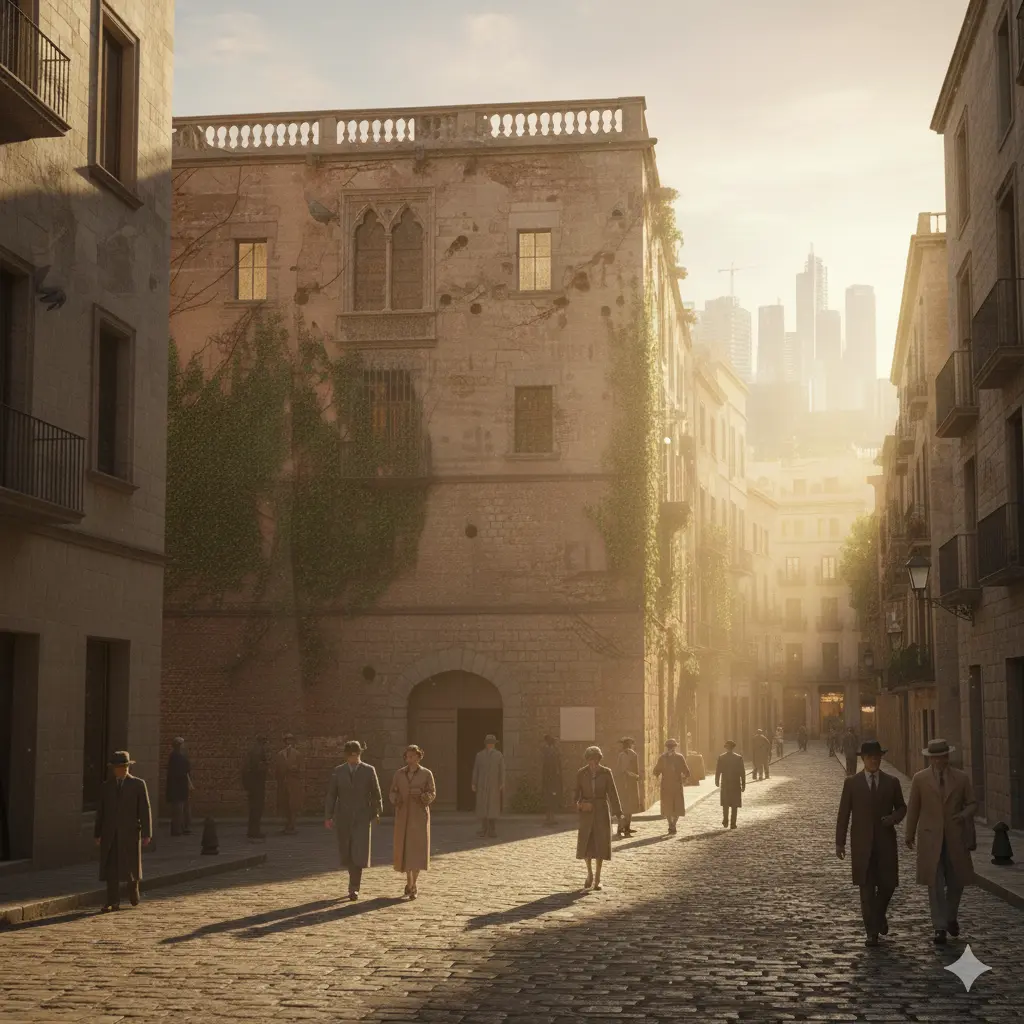
20th Century Barcelona: Reconstruction and Resilience Guide
When you arrive in Barcelona in 2026, it is easy to get lost in the medieval charm of the Gothic Quarter or the whimsical curves of Gaudi. But there is another layer to this city—a layer of grit, survival, and dramatic transformation that occurred between the Roaring Twenties and the late 1980s. This is the story of Barcelona in the 20th Century.
For the first-time traveler, understanding this era is the secret handshake to connecting with the locals. It explains why the Catalan flags hang from balconies, why the football stadium is treated like a cathedral, and why the city feels so passionately alive. It is a story of a city that hosted the world, suffered a devastating war, endured decades of silence, and then reconstructed itself into the vibrant metropolis you see today.
This guide will take you beyond the postcards and into the heart of Barcelona's modern history, showing you the traces of the past that are still visible if you know where to look.
The Prelude: The 1929 International Exposition
Before the turmoil, there was a party. To understand the 20th century, you have to start with the city's second great expansion: the 1929 International Exposition. This event was designed to show the world that Barcelona was a modern, industrial powerhouse.
The Conquest of Montjuïc
Then: Before 1929, the hill of Montjuïc was largely undeveloped, used mostly for military fortifications and agriculture. It was the "mountain" that overlooked the city but wasn't part of it.
The Reconstruction: To host the world, the city transformed the north slope of the hill. They built grand palaces, the "Magic Fountain," and the Poble Espanyol. This massive urban landscaping project connected the city to its green lung.
Now: Today, this area is one of the most majestic parts of Barcelona. It is grand, spacious, and filled with museums.
Where to find it: To truly grasp the scale of this 20th-century landscaping, you need to see it from above. The Montjuïc Cable Car is the perfect way to experience this.
- The Experience: As you glide over the hill, you are looking down on gardens and architecture that were terraformed nearly 100 years ago. It offers a stark contrast to the dense city grid below.
- Insider Tip: In 2026, try to ride the cable car just before sunset. You will see the city lights turn on, illuminating the grand avenue leading from Plaça d'Espanya to the National Palace.
- Location: Montjuïc Cable Car on Google Maps
The Civil War: Scars in the Stone
The optimism of 1929 was short-lived. By 1936, the Spanish Civil War had erupted. Barcelona was a key stronghold for the Republican forces (fighting against Franco's Nationalists), and as a result, it became a city at the center of events.
The First Aerial Bombings
Barcelona holds the tragic distinction of being the first major city in history to be systematically bombed from the air by modern aircraft. For three years, the citizens lived with the sound of sirens.
Traces of History You Can Still See: You don't need to visit a museum to feel this history; it is etched into the walls.
- Plaça de Sant Felip Neri: Hidden deep in the Gothic Quarter, this is perhaps the most moving square in the city.
- What to look for: Look at the façade of the baroque church. You will see heavy pockmarks and gouges in the stone. These are not from age; they are shrapnel scars from a bomb that fell in January 1938, tragically claiming the lives of 42 people, mostly children who had sought refuge in the church.
- The Atmosphere: Today, it is a quiet, leafy square often filled with the sound of a fountain and children playing from the nearby school. It is a powerful symbol of life continuing despite the scars.
- Location: Plaça de Sant Felip Neri on Google Maps
The Underground City
To survive the raids, the people of Barcelona achieved a feat of engineering and solidarity: they dug. They built over 1,300 air-raid shelters (refugis) by hand.
Refugi 307: Unlike the rough basements used in other cities, these were sophisticated tunnels with electricity and infirmaries.
- The Visit: You can visit Refugi 307 in the Poble Sec neighborhood. Walking through these tunnels gives you a visceral sense of the resilience of the 20th-century locals. It is a sobering, essential experience to understand the Catalan spirit.
- Note: In 2026, booking ahead is essential as entry numbers are limited to preserve the structure.
The Grey Years: Survival of Identity
After the war ended in 1939, a dictatorship was established that lasted until 1975. Locals often refer to this as "The Grey Years." Public use of the Catalan language was banned, cultural institutions were closed, and the vibrant colors of the city were muted.
However, culture didn't disappear; it just went underground or found new sanctuaries.
Football as a Sanctuary
This era explains why FC Barcelona is "Més que un club" (More than a club).
Then: During the dictatorship, the football stadium was one of the few places where thousands of people could gather safely. Speaking Catalan or waving the flag was forbidden in the streets, but inside the stadium, it became an act of collective defiance. It was a pressure valve for a repressed society.
Now: The FC Barcelona Museum at Camp Nou is one of the most visited museums in the country. Even if you aren't a sports fan, visiting here is a lesson in sociology. You aren't just looking at trophies; you are looking at a symbol of 20th-century resistance.
- What to expect: In 2026, you will likely see the fully renovated stadium, a blend of historical significance and futuristic design.
- Location: FC Barcelona Museum on Google Maps
Artistic Resistance
While politics were frozen, art was alive. Artists like Joan Miró and Pablo Picasso became symbols of freedom. Picasso, who spent his formative years in Barcelona, refused to return to Spain while the dictator was alive, but he ensured his art did.
The Picasso Museum: Opened in 1963 (during the dictatorship), the Picasso Museum Barcelona was a subtle act of rebellion, founded by the artist's friends. It focuses on his early years and his relationship with the city.
- Comparison: Today, the El Born district where the museum sits is a hub of creativity. Just a few doors down, you can visit the Moco Museum, which houses modern and street art (like Banksy). Seeing these two museums side-by-side offers a perfect timeline: from the 20th-century avant-garde resistance of Picasso to the 21st-century social commentary of street art.
- Location: Picasso Museum Barcelona on Google Maps
The Cultural Mix: Migration and Flamenco
The 20th century also changed the people of Barcelona. In the 1950s and 60s, waves of migrants arrived from the south of Spain (Andalusia) to work in the factories rebuilding the city. They brought their own culture, food, and music, which eventually blended into the city's fabric.
The Arrival of Flamenco
While Flamenco is native to Andalusia, Barcelona became a secondary capital for the art form during this reconstruction era. The legendary dancer Carmen Amaya was born in the Somorrostro shantytowns on the Barcelona beach.
Where to experience it: To honor this blend of cultures, attend a show at the Barcelona City Hall Theater.
- The Vibe: Located in a historic 19th-century building, the Flamenco Show here captures the passion and grit that defined the migrant experience of the 20th century. It is a reminder that Barcelona is a mosaic of different Spanish cultures.
- Location: Barcelona City Hall Theater on Google Maps
The Stalled Dream: Sagrada Familia in the 20th Century
We cannot talk about this century without mentioning the city's icon. The Sagrada Familia suffered greatly during this period.
Then: During the Civil War turmoil, revolutionaries broke into the workshop and burned Gaudí’s original plans and plaster models. For decades after, reconstruction of the church moved at a snail's pace. It was a ruin of a dream, standing over a recovering city.
Now: As you look at the basilica in 2026, pay attention to the stone. You can visually see the history: the weathered, dark stone of the Nativity Façade (completed before the war) contrasts sharply with the pale, clean-cut stone of the Passion Façade (built in the late 20th century). The building itself is a timeline of the city's reconstruction.
- Location: Sagrada Familia on Google Maps
Reclaiming the City: The Transition to Democracy
When democracy returned in the late 1970s, Barcelona began to wake up. The city started to reclaim spaces that had been off-limits or neglected.
From Fortress to Park
The Parc de la Ciutadella has a complex history. Originally a military citadel built to control the city, it was slowly reclaimed by the people. In the 20th century, it solidified its status as the city's "green lung."
The Barcelona Zoo: Located inside the park, the Barcelona Zoo became a focal point for families during the reconstruction years. It was a place of leisure in a city that worked hard. Today, it focuses on conservation and education, serving as a peaceful break from the urban stone.
- Location: Barcelona Zoo on Google Maps
Turning to the Sea
For most of the 20th century, Barcelona lived with its back to the sea. The coastline was industrial, filled with factories and train tracks. It wasn't until the late 80s (in preparation for the 1992 Olympics) that the city demolished the industrial barrier and "found" its beaches again.
The Recovery of the Port: The Barcelona Aquarium in Port Vell stands on land that was once gritty and industrial. Now, it is a celebration of the Mediterranean. Visiting here is a great way to see how the city transformed its waterfront from a working port into a leisure district.
- Location: Barcelona Aquarium on Google Maps
Practical Guide for the 2026 Traveler
Understanding the 20th-century context will change how you navigate the city. Here is how to make the most of your visit.
Best Time to Explore History
- Morning: Visit the Plaça de Sant Felip Neri before 10:00 AM. It is part of a schoolyard now, so it gets noisy during recess. Early morning offers the silence needed to appreciate the history.
- Late Afternoon: The Montjuïc area is best in the late afternoon when the sun is less harsh, and the views from the cable car are golden.
Costs and Budgeting
- Free History: Walking the streets to see the bomb scars or the exteriors of the industrial-era markets is free.
- Museums: Expect to pay between €15 and €30 for major museums like the Picasso Museum or FC Barcelona Museum.
- Flamenco: A good show usually costs between €30 and €50, sometimes including a drink.
Traveler Etiquette
- Sensitivity: When visiting memorial sites like the Civil War bunkers or Sant Felip Neri, keep voices low. These are places of deep emotional significance to locals.
- Language: The suppression of Catalan in the 20th century makes locals very proud of it today. You will hear it everywhere. A simple "Bon dia" (Good morning) goes a long way in showing respect for their identity.
- Safety: Barcelona is a safe city, but in busy areas like the Gothic Quarter or outside major museums, always be aware of your surroundings. Keep your bags zipped and close to you.
Getting Around
The 20th-century expansion connected the old city to the outlying villages (now neighborhoods like Gràcia and Sants).
- Metro: The metro system is the legacy of this expansion. It is efficient, air-conditioned, and the best way to move between the Sagrada Familia and the Montjuïc area.
Conclusion: A City of Layers
Barcelona is not just a pretty face; it is a survivor. The 20th century was a fire that forged the city's modern character. It taught the people the value of their culture, their language, and their public spaces.
When you walk past the Casa Batlló, admire its beauty, but remember that it stood silent witness to tanks rolling down the Passeig de Gràcia. When you cheer at a football match, know that you are participating in a ritual of freedom. And when you look at the Mediterranean from the Montjuïc Cable Car, appreciate that the beautiful view was a hard-won victory of reconstruction.
In 2026, you are visiting a city that has healed, rebuilt, and decided to celebrate life. Enjoy every moment of it.
Quick Reference: 20th Century Highlights Itinerary
A suggested flow to see the reconstruction era highlights.
- Start: Montjuïc Cable Car (The 1929 expansion view).
- Visit: Plaça de Sant Felip Neri (Civil War memorial).
- Culture: Picasso Museum Barcelona (Artistic resistance).
- Contrast: Moco Museum (Modern artistic freedom).
- Explore: FC Barcelona Museum (Sports as identity).
- Relax: Barcelona Zoo or Barcelona Aquarium (Reclaimed spaces).
- Evening: Barcelona City Hall Theater: Flamenco Show (The cultural mix).